5 Brilliant Books on Brand.
I have a weakness for books. Recommend one and I've probably ordered it before telling me why I should read it. Over the past 20+ years, I've accumulated a collection of books about branding, although the relationship hasn't always been healthy.

Some books I've read once, others I've practically worn out, and a few I've purchased multiple times because apparently lending books to colleagues is my preferred method of making charitable donations.
The problem is that there are a lot of shitty books about branding. Not necessarily because the authors are wrong, but because so many have remarkably little to say. There's only so much enthusiasm I can muster for another 250 pages explaining that brands need purpose, authenticity and storytelling, preferably accompanied by a Venn diagram and a case study about Apple. Yes, your brand is more than your logo. We've established that.
Can we please move on?
What I want from a branding book is perspective, experience and uncomfortable truths. Tell me something that I should be doing but I currently am not. I want to understand how people who have actually built brands think, how their decisions shaped the work, and what I might learn from their successes and mistakes. Beautiful pictures are certainly welcome, but so is a little intellectual substance.
What I want from a branding book is perspective, experience and uncomfortable truths. Tell me something that I should be doing but I currently am not.
The following books have earned their places on my shelves for very different reasons. Some helped shape my thinking early in my career, while others continue to challenge it. They're books I return to when I need inspiration, reassurance or a reminder that branding is a discipline requiring more than an enthusiastic opinion, colorful gel pens, and a Canva subscription.
And yes, I've developed some rather personal relationships with a few of them.

Be the Brand: How to Find a Powerful Identity and Use It to Drive Sales
David N. Martin
Let's start with the late David N. Martin, founder of The Martin Agency and a man who unknowingly played a rather important role in my early creative education.
When I lived in Richmond, The Martin Agency was the Emerald City. It was home to some extraordinary creative talent, and for a young graphic designer trying to figure out where he belonged in the advertising world, it represented everything I wanted to be part of.
After graduating from Virginia Commonwealth University in 2003, I was furious that I hadn't immediately made my way into VCU Adcenter. In retrospect, I had plenty left to learn, but at 22, I was quite confident the institution had made a terrible mistake. Rather than spending the next several months just sulking, I wandered into Barnes & Noble, discovered Martin's Be the Brand, and began studying it with devotion. Coincidentally, when I started working at Circuit City, I'd sneak over to Border's during my lunch and often run into Mike Hughes, then president of the Martin Agency, who apparently shared my love of books. I shyly introduced myself, didn't dare ask for a job, and would say 'hello' every time I'd see him. RIP Mike and RIP Border's.
Be the Brand is not a particularly beautiful book. In fact, judging strictly by its cover, you might question whether the author should be allowed to discuss branding at all. But don't let the packaging fool you, because what's inside is tremendously valuable.
Martin shares experiences and case studies from a career spent helping build brands, offering an unusually candid look at the thinking behind the work. He isn't recycling somebody else's theories or presenting a collection of observations from the sidelines. He's explaining what happened, why decisions were made and how those decisions contributed to something bigger. For someone starting out, that kind of access to an experienced creative and strategic mind was invaluable.
For someone starting out, that kind of access to an experienced creative and strategic mind was invaluable.
I particularly appreciate that Martin doesn't treat branding as some mystical practice requiring a charismatic consultant to reveal its secrets. He understood the relationship between identity, creativity, behavior and business long before everyone with a LinkedIn account started declaring themselves a brand strategist.
I once worked with a leader who had virtually no branding experience, read a branding book over the weekend and returned on Monday seemingly prepared to assume the role of resident expert. I wish I were exaggerating, but the experience remains one of my favorite examples of how quickly confidence can outrun competence.
If you're determined to become a branding expert between Friday afternoon and Monday morning, I suppose you could do worse than spending the weekend with David N. Martin. Just don't confuse finishing the book with having done the work.

A Brand Is an Onion
Hugh Wilson
If you happen to be in Paris, achetez ce livre! If you're in the United States, prepare to pay a rather ridiculous price for it, assuming you can find a copy. Mine has a wonderfully soft, almost velvety cover that has become inexplicably sticky with age. It's a peculiar physical relationship to have with a book, but we've been together long enough that I've learned to overlook its flaws.
Hugh Wilson's premise is beautifully straightforward: every aspect of a brand is branding, just as every slice of an onion is unmistakably onion. It's one of those ideas that seems obvious once somebody articulates it, which is usually the mark of someone who understands a subject exceptionally well.
What makes this book especially refreshing is its Anglo-French perspective. There's something liberating about stepping outside the American approach to branding, which can become so preoccupied with process, guidelines and corporate terminology that we occasionally forget we're supposed to be creating something people actually care about.
There's something liberating about stepping outside the American approach to branding...
Wilson understands that brands are shaped by culture, management, creativity and the countless interactions people have with them. He also recognizes the importance of emotion, something that can be difficult to quantify in a spreadsheet and therefore tends to make certain business leaders deeply uncomfortable.
I appreciate brand standards as much as the next creative director, but nobody has ever fallen passionately in love with a company because its logo maintained the required minimum clear space.
The book contains 43 relatively short chapters, organized around culture, management, creativity and techniques. It's wonderfully approachable and doesn't demand that you read it in sequence. You can spend an afternoon with it, dip into a few chapters between meetings or enjoy a little branding enlightenment while sitting on the toilet. I won't judge your reading habits, provided you wash your hands before returning the book to my shelf.
More importantly, Wilson encourages a broader, more human understanding of branding. American creatives could benefit from occasionally looking beyond our own industry's conventions, and this book is a delightful place to start.

The Brand Gap: How to Bridge the Distance Between Business Strategy and Design
Marty Neumeier
I'm reasonably certain I slept with The Brand Gap under my pillow during my early years in the industry. I can't prove it, but given how frequently I reached for it, I wouldn't be surprised.
Marty Neumeier has written several excellent books about branding, but this remains one of my favorites because of its remarkable clarity. Described as a "whiteboard overview," it does something that many branding books seem constitutionally incapable of doing: it makes its point without requiring 200 additional pages to explain how clever the author is. The main points are beautifully sticky.
“Differentiate or die.” — Marty Neumeier
You can read it in a day, although you'll probably find yourself returning to it for years. Neumeier bridges the relationship between business strategy and design with an economy of language and visual thinking that feels particularly natural to creatives. He makes complicated ideas accessible without making them simplistic, which is a much more difficult achievement than it appears.
I've also developed a peculiar habit of reaching for this book whenever I hear somebody butcher the definition of a brand. After a particularly painful meeting, a few pages of Neumeier can be wonderfully restorative. It's the professional equivalent of taking an antacid.
I recently had the pleasure of hearing Neumeier speak at the Brand Builders Summit, and it was gratifying to discover that the clarity I admired in his writing carries through to the way he speaks. There's no unnecessary performance around his expertise. He understands the material, respects his audience and gets to the point.
I sometimes wish The Brand Gap (also The Brand Flip, Zag, Scramble...) were required reading before certain business meetings. Not because everyone needs to become a brand strategist, but because we'd accomplish considerably more if we could agree on what we're actually talking about before spending an hour arguing over it.

Designing Brand Identity: An Essential Guide for the Whole Branding Team
Alina Wheeler
I've purchased Designing Brand Identity several times over the years, partly because updated editions have continued to justify the investment and partly because I've loaned copies to colleagues who apparently interpreted my generosity as a transfer of ownership.
At this point, I should probably start stamping my name inside them like an elementary school librarian.
Alina Wheeler created one of the most practical and comprehensive resources available to anyone working in brand identity. The book has evolved alongside the industry, incorporating new thinking, examples and approaches while retaining the fundamentals that make it so useful.
I've relied on it throughout my career, whether working in television news marketing, advertising agencies, design studios, in-house creative departments or on my own projects. Different environments present different challenges, but the underlying questions about identity, differentiation, consistency and implementation remain remarkably familiar.
What I particularly value is the structure Wheeler brings to a discipline that is frequently misunderstood, even by the people commissioning the work. Creatives are often handed assignments that sound straightforward until you begin asking the questions necessary to do them properly. Suddenly, what started as a request for a new logo becomes a conversation about organizational positioning, audience perceptions, brand architecture and business objectives. That's not creative people making things unnecessarily complicated. That's discovering the actual assignment.
Creatives are often handed assignments that sound straightforward until you begin asking the questions necessary to do them properly.
Designing Brand Identity can feel like a textbook, and I consider that a compliment. It provides methodologies, examples and language that help creatives navigate ambiguity, explain their recommendations and build credibility with people who may have very different levels of experience with branding. I've found that adapting Wheeler's frameworks to your own work and presentations not only strengthens your recommendations but also demonstrates the credibility and expertise behind them. Fuck. Now my secret is out.
No, seriously. I've learned a tremendous amount from this book, and I suspect it's helped me make more persuasive recommendations than I could possibly count. When you're able to explain not just what you recommend but why, the relationship between creative teams and their stakeholders becomes considerably more productive.
If you're serious about working in branding, buy a copy. You'll use it. And if you happen to borrow mine, I'd appreciate getting the damn thing back.
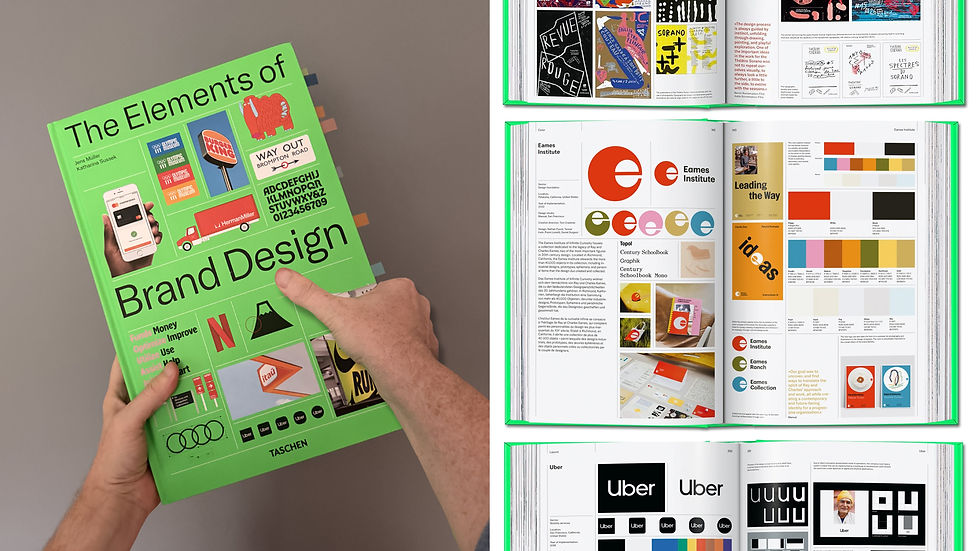
The Elements of Brand Design
Jens Müller and Katharina Sussek
I've been waiting for a book like this for years, and leave it to Taschen to deliver something so beautiful that I briefly considered rearranging my furniture to accommodate it.
The Elements of Brand Design is an extraordinary collection of brand identities and their applications from around the world. It's also heavy as fuck, which makes it simultaneously an excellent design reference and a potentially effective home-defense instrument.
What I love about this book is its emphasis on how identities live beyond the logo. There are examples of typography, packaging, environments, signage, advertising and countless other expressions of a brand. Seeing these elements together reinforces something that can get lost in the endless parade of logo reveals online: designing a compelling identity is only the beginning. The real challenge is creating a system that can function beautifully across an enormous range of applications.
For years, I devoured issues of Communication Arts, studying the work with equal measures of admiration, curiosity and professional jealousy. There is a particular pleasure in discovering something so good that your immediate reaction is, "Dang nab it, I wish I'd thought of that."
This book brings back that feeling. I'll spend several minutes studying one identity, wondering how the designers arrived at a particular solution, then turn the page and discover something completely different that makes me question everything I thought I knew five minutes earlier.
It's also a reminder of what's possible when talented creative teams are given the trust, resources and time to develop something meaningful. The best examples demonstrate a level of consistency and imagination that rarely happens by accident. Behind those beautifully resolved systems are countless decisions, conversations, experiments and probably a few arguments worth having.
It's also a reminder of what's possible when talented creative teams are given the trust, resources and time to develop something meaningful.
Another reason I appreciate this collection is its international perspective. American creatives can become a little too comfortable looking at the same agencies, brands and award shows for inspiration. There is extraordinary work happening around the world, often informed by cultural influences and visual traditions that deserve far more attention than they receive here.
Books like this remind me why I fell in love with design and branding in the first place. There's always something new to discover, another perspective worth considering and another creative solution that makes you wish you'd been in the room when it happened.
Unlike The Brand Gap, however, I have no intention of sleeping with this one under my pillow. I'm passionate about branding, but I'd prefer to retain full mobility in my neck.

A Good Book Doesn't Make You a Brand Expert
If there's one thing these books have taught me, it's that understanding branding requires curiosity, experience and a willingness to challenge what you think you know. The authors approach the discipline from different perspectives, but they share something important: they have genuine knowledge worth passing along.
I don't believe reading a handful of books makes anyone an expert, regardless of how many passages they've highlighted or how confidently they can discuss brand archetypes at a networking event. Expertise develops when you put ideas into practice, discover what works, make mistakes and develop the judgment to recognize the difference.
Expertise develops when you put ideas into practice, discover what works, make mistakes and develop the judgment to recognize the difference.
But good books can make you better at that work. They can expand your thinking, challenge your assumptions and occasionally save you from making an expensive mistake.
And if they happen to look beautiful on a shelf, I consider that a perfectly legitimate additional benefit.
Now, if you'll excuse me, I have a few books in my shopping cart that I absolutely do not need.
Comments